
As we move through 2026, the concept of the “home” has undergone a radical shift. No longer just a place to reside, the modern home is now a high-performance sanctuary that balances advanced technology with a deep, soulful connection to the natural world. The home design trends of 2026 reflect a society that values mental well-being, environmental responsibility, and the seamless integration of artificial intelligence into daily rituals.
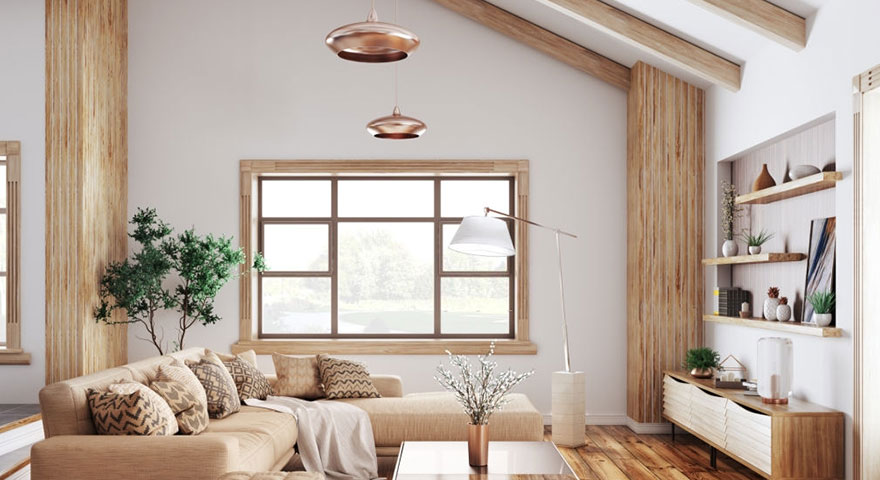
From the “tactile minimalism” of living rooms to the “biological optimization” of bedrooms. The architecture and interior design of this year are focused on creating environments that actively improve the quality of human life. This article explores the defining characteristics of home design in 2026.
Biophilic Urbanism: Bringing the Wild Indoors
The most prominent trend in 2026 is the evolution of biophilic design. While previous years saw a surge in simple houseplants, 2026 has embraced “integrated nature.” We are seeing homes designed with built-in irrigation systems for indoor “micro-forests” and moss walls that act as natural air purifiers.
Architects are now prioritizing “circadian lighting systems” that mimic the exact color temperature and intensity of the sun throughout the day. This technology is paired with larger, high-performance glass walls that blur the line between the interior and the garden. The goal is to reduce “nature deficit disorder” by ensuring that even in the heart of a city. A resident feels connected to the cycles of the Earth. Natural materials like unrefined stone, cork, and reclaimed timber are being used not just for their beauty. But for their ability to ground the human nervous system in an increasingly digital world.
The AI-Enhanced “Cognitive Home”
In 2026, the “Smart Home” has matured into the “Cognitive Home.” We have moved past voice-controlled lights and entered an era where the home environment is managed by localized AI that anticipates needs.
Modern home designs now feature “Invisible Tech.” Instead of bulky gadgets, sensors are woven into the fabric of the building. Smart glass automatically tints based on the intensity of the glare, and flooring materials can now monitor the gait and health of elderly residents. Alerting family members to potential falls or health irregularities. In the kitchen, AI-integrated cabinetry tracks food freshness and suggests recipes based on nutritional deficiencies detected by wearable health monitors. This tech is designed to be felt, not seen, allowing the home’s aesthetic to remain organic and uncluttered.
Tactile Minimalism and Emotional Textures
The sterile, “all-white” minimalism of the early 2020s has been replaced by what designers call “Tactile Minimalism.” In 2026, the focus is on how a room feels to the touch. This year’s interiors are dominated by rich, sensory-heavy textures that provide comfort and warmth.
We are seeing a resurgence of lime wash walls, hand-applied plaster, and bouclé fabrics. Furniture design has moved away from sharp, aggressive angles toward “curvilinear” shapes. These rounded edges and flowing lines are more than just an aesthetic choice. They are rooted in neuro-aesthetic research which suggests that curved environments reduce cortisol levels and encourage a sense of safety. The color palette of 2026 is anchored in “Earthy Neutrals”—terracotta, sage green. And deep ochre—providing a serene backdrop to the complexities of modern life.
The Multi-Functional “Flex-Zone”
With the permanent shift toward hybrid work and home-based entrepreneurship, the “spare room” has become obsolete. In its place, 2026 home plans feature “Flex-Zones.” These are highly engineered spaces designed to transform throughout the day.
Utilizing robotic furniture and acoustic sliding partitions, a single room can serve as a professional video-conferencing studio in the morning. A yoga retreat in the afternoon, and a soundproof cinema room in the evening. This trend is a response to the rising cost of urban real estate, requiring homeowners to maximize the utility of every square meter. Design in 2026 is about “spatial agility,” ensuring that the home can adapt to the changing needs of its inhabitants without requiring a renovation.
Regenerative and Earth-First Architecture
Sustainability in 2026 has moved beyond “doing less harm” to “doing more good.” Regenerative architecture is the new gold standard. Homeowners are increasingly choosing “Carbon-Negative” building materials, such as hempcrete and cross-laminated timber (CLT), which store more carbon than was used to produce them.
Energy independence is no longer a luxury but a standard feature. New homes in 2026 are often equipped with “Solar Skins”—photovoltaic cells integrated directly into the roof shingles or window glass. Additionally, greywater recycling systems have become more compact and affordable. Allowing households to reuse water from showers and sinks to irrigate indoor gardens. The home of 2026 is a closed-loop system that produces its own energy and manages its own waste.
Conclusion
Home design in 2026 is a sophisticated blend of the primitive and the futuristic. It recognizes that while we have incredible technological capabilities, our biological needs for light, nature, and tactile comfort remain unchanged. By combining AI-driven efficiency with biophilic beauty and regenerative materials, the homes of this year are more than just shelters; they are active partners in our health and happiness. As we continue to navigate the 21st century, the 2026 design philosophy serves as a reminder that the best technology is that which disappears, leaving us closer to ourselves and the world around us.